Retrospectives are the last thing a team does during a Sprint. There are a wide variety of approaches and formats one can use for Retrospectives, but the one thing all have in common is that the Retrospective must produce tangible results. One extremely effective way I have found to help ensure that the Retrospective meets this vital goal is to build a Team Improvement Backlog using the items the team identifies as action items.
A Team Improvement Backlog is nothing more than a prioritized list of action items the team comes up with during its Retrospectives. The most common recommendation, and one I heartily endorse, is that the team collectively chooses the top one or two items on the Team Improvement Backlog at or near the end of each Retrospective and then decides how to implement them and how to demonstrate success. Just like user stories, Team Improvement Backlog items need to have acceptance criteria -- the all-important definition of done.
There are a couple of nuances that can play into management of the Team Improvement Backlog. In general, items teams add to their improvement backlogs are public in keeping with the agile and Scrum values of openness and transparency. There are occasions, however, when I have recommended that certain items be kept private to the team. Examples include specific team interaction items, particularly when those items address individual behaviors. Retrospectives are sometimes more like the closed locker room meetings sports teams hold when they are experiencing a crisis. Teams typically do not allow reporters or even coaches into the locker room during such meetings simply because what the team members have to say to each other is strictly for their benefit as a team. In my coaching experience, private improvement backlog items are rare, but it's a handy tool to have in your bag especially when teams are storming.
Keep the Team Improvement Backlog visible in the team room and track progress at each Retrospective at the latest. Individuals who take on improvement items should also be talking about their work and plans during the Daily Scrum.
If you're not already using a Team Improvement Backlog, add this handy tool to your repertoire and use it to help your teams grow.
All for now....
...-.-
Friday, December 10, 2010


Wednesday, December 8, 2010
ScrumMaster Dilemmas
A few weeks ago, during a Product Owner class I was teaching, the lone practicing ScrumMaster in the room raised his hand after I had finished the section of the course reviewing Scrum roles. His question was basically this: "So, you just said one of the ScrumMaster's functions is to be a bulldozer, but when I solved a problem for my team last week, they accused me of 'throwing them under the bus' and now they won't talk about impediments anymore. What am I supposed to do?"
After learning more about the situation, I understood what had happened. At the last Retrospective, the team had raised an issue they were having with their Product Owner and, seeing himself as the fullback, snowplow, bulldozer, problem-solver, the ScrumMaster had simply taken the team's concerns to the Product Owner and worked out a solution. When he (the ScrumMaster) reported back to the team during a Daily Scrum his progress in resolving the issue with the Product Owner, the team reacted very negatively, as the ScrumMaster had described in his original question.
His confusion and genuine sense of hurt were palpable. He thought his role was to clear the road for the team so that they could get their work done as efficiently and effectively as possible. His point is entirely valid, but his experience demonstrates one of the many dilemmas that face ScrumMasters.
Take it to the team!
In her excellent book*, Lyssa Adkins gives this advice again and again. Self-organizing teams need to be empowered to solve their own problems -- or at least to devise prospective solutions to the problems they face. The ScrumMaster in my class did not realize that self-organizing teams, even those that have only been practicing for a few months, do not want to be presented with solutions to problems. Instead, as Lyssa points out, self-organizing teams want, and need, to be presented with problems. The team is then empowered to devise solutions -- and the team's solution will be the best one for that team. It may not be the solution the ScrumMaster would have chosen, but that does not change this essential fact.
Despite the best of intentions, ScrumMasters run into difficulties with their teams when they take on problems and solve them without team involvement. The team may ask their ScrumMaster to implement the solution to a problem, but the team itself needs to solve the problem. Many ScrumMasters came from backgrounds where individual problem solving was a major part of their job descriptions. Perhaps they were even evaluated on the basis of their individual problem-solving prowess. In a Scrum (or other agile framework) team environment, the equation changes. Problem solving abilities are still valuable, but within the context of of the self-organizing team.
ScrumMasters must engage in a delicate balancing act, being the bulldozer, fullback, or snowplow for their team, yet not imposing solutions on the team. It is more difficult to achieve this balance when a ScrumMaster is responsible for more than one team. Under pressure to help their teams succeed and with a severely limited amount of time and attention to offer to each team, such ScrumMasters are naturally inclined to gather lists of problems and run with them, handing solutions to their teams in rapid succession. This situation is bad for the teams, stunting their growth and inviting resentment against their ScrumMaster; it is also bad for the ScrumMaster who never really has time to get to know each team and the various individuals at the depth necessary to achieve the highest degree of effectiveness.
So what's a ScrumMaster to do? "Take it to the team," let the team solve problems, and keep the wolves at bay.
All for now....
...-.-
*Lyssa Adkins, Coaching Agile Teams: A Companion for ScrumMasters, Agile Coaches, and Project Managers in Transition. Upper Saddle River, NJ: Addison-Wesley, 2010.
Monday, October 25, 2010
Scrum is more than just iterative and incremental
People often talk about Scrum as if it were nothing more than an iterative, incremental development process. Taking just these two aspects of Scrum makes it seem like it would be easy just to bolt Scrum onto existing development practices and organizational structures. I have trained and coached and talked -- either in person or on discussion lists -- with people who were completely comfortable calling their functionally delimited, mini-waterfall processes "Scrum" or "Agile."
"Well, we deliver a release every month that builds on previous month's release," is a common refrain.
A few quick questions reveal what's actually going on:
"Great! How's your quality? Is it getting better with each release? Are your teams getting better? Does every release contain the most valuable features you could possibly deliver?"
"Um, well...." is the usual response when an organization has adopted the superficial qualities of Scrum while ignoring the deeper principles and the practices they inform.
Iterative and incremental development are two results of Scrum done well, not the essence of Scrum. So what, you ask, is the essence of Scrum? I believe Scrum is about building cross-functional teams that are capable of learning how to do better work every day. Focusing on working software as the primary measure of progress by making use of the Sprint and daily planning cycles and the Sprint Review (to show our work) provides the framework for technical innovation -- and more basically, getting the job done, which is a huge challenge by itself in most organizations. The Retrospective gives teams the mechanism to improve both their degree of teamwork and, to a greater or lesser extent, the organizational environment in which they work. Learning teams, when propagated and nurtured, produce learning organizations that have a built-in competitive advantage over their less dynamic competitors.
Scrum is also about letting go of false measures, unrealistic planning, and failed control mechanisms. Measuring team throughput (Velocity) rather individual utilization provides a realistic tool for planning. The planning itself changes from activity and milestone-based to feature- and value-based, using teams' demonstrated ability to deliver working software as the key metric. Having teams pull work from the top of a prioritized Product Backlog ensures that, by definition, the highest-priority features are being worked on at all times and that each release contains the highest-priority, and therefore most valuable, features that could be delivered. Finally, allowing teams to deliver features, instead of relying the thoroughly discredited industrial practice of externally assigned individual tasks, opens the door to creative solutions -- and breakthrough productivity.
Where does quality fit into all of this? Returning again to the agile principle of working software as the primary measure of progress, non-working, buggy, software cannot demonstrate progress and therefore cannot be called "done." Teams and organizations that hold true to this principle have the capacity to do truly amazing things in an industry too often characterized by the poor quality of its products.
This is by no means a comprehensive list, but for me, right now, these are the key features of Scrum.
All for now....
...-.-
Tuesday, September 28, 2010
WFH Scrum
Working From Home (WFH) is an amazing thing. I have done it for years, off and on, and I really like it. Studies have repeatedly shown that people are more motivated, more focused, and more productive when working from home than when working at the office. Another major benefit is for people who face long daily commutes. Not only do they not have to spend two or more hours of utterly unproductive time driving to and from the office, people working from home also reduce traffic volume and air pollution, both major concerns where I live on the Front Range of the Rocky Mountains of Colorado.
But how does one accommodate WFH within a Scrum team? I have coached a few teams that wrestled with this issue. It is tempting to say "everyone needs to be here, every day." And indeed, that is the only way to ensure the highest-possible bandwidth communication within a team. Given my own affinity for WFH, however, I decided the dogmatic approach would be neither effective nor realistic.
The approach I have adopted consistently -- and successfully -- is to work with the team to make sure everyone understands the importance of the principle of face-to-face communication and then recommend a few WFH ground rules for the team's consideration:
Let me know if you find these suggestions reasonable, useful -- or not.
All for now....
...-.-
But how does one accommodate WFH within a Scrum team? I have coached a few teams that wrestled with this issue. It is tempting to say "everyone needs to be here, every day." And indeed, that is the only way to ensure the highest-possible bandwidth communication within a team. Given my own affinity for WFH, however, I decided the dogmatic approach would be neither effective nor realistic.
The approach I have adopted consistently -- and successfully -- is to work with the team to make sure everyone understands the importance of the principle of face-to-face communication and then recommend a few WFH ground rules for the team's consideration:
- During the first Sprint or two, everyone needs to be physically present while we learn how to apply the rules of Scrum in practice
- When the team decides it is ready to run a WFH experiment, I suggest the following ground rules:
- Everyone is present for Sprint Planning, Story Time, Sprint Review, and Retrospective, which generally works out to be three days in each two-week Sprint
- Use Skype or other video conferencing technology to facilitate the Daily Scrum -- voice-only dial-in may suffice temporarily, but is not adequate over the long-term
- The team needs to adopt a standard, high-bandwidth communication medium/technology, such as Skype with video, that all team members commit to use for daily collaboration
- The Daily Scrum rules: if team members decide pairing or other face-to-face contact is needed, the necessary team members must be physically present even if it means driving to the office after the Daily Scrum, although we try to avoid the latter whenever possible
- Try to give people as much predictability as possible, but the team's needs trump all else
Let me know if you find these suggestions reasonable, useful -- or not.
All for now....
...-.-
Friday, September 10, 2010
Rehumanize Your Work
I was -- and remain -- a big fan of the popular music that characterized the 1980s. One of my favorite bands was The Police and one of my favorite songs was "Rehumanize Yourself" from their album Ghost in the Machine. That song was never a radio-play hit, but it always hit home with me. Listening to that album the other day on my iPod reminded me why it is exactly that I now spend my working life at what is essentially Agile evangelism.
Many of the key reasons companies decide to adopt Agile are based on hard-nosed financial, business, value, and competitiveness calculations. And that is as it should be. After all, without a competitive business there would be no employment. So yes, the competitive boost companies derive from Agile is a key benefit. But for me, the greatest benefit is the rehumanization of work and of the workplace.
Among the most insidious results of Frederick Winslow Taylor's Scientific Management was the utter and complete de-humanization of work and the workplace. In the software development world, the various pre-packaged methodologies that have come along have all contained the spirit of Taylorism with its cynical, command-and-control approach to the people doing the work.
The real genius of the Toyota Production System, to me, was its inventors' realization that the assembly line was not mechanistic; it was, in fact, a social system that could only work properly if it took into account the human element. The result was the andon cord, which gave all workers on the floor both the responsibility and the authority to control their work.
Henry Ford once said: "Why is it that when I want to hire a pair of hands, a brain comes attached to them?" This is the essence of Taylorism -- and the antipathy of the entire concept of the andon cord. No worker in any of Henry Ford's factories was ever given authority to stop the line.
Software development -- or any other type of product development -- obviously requires hands that are attached to a brain, but traditional methodologies assume that the brain thus involved must be allowed to work only within rigid constraints because the people doing the work obviously have neither the capacity nor the inclination to take responsibility for their work. This, too, is the essence of Taylorism.
The genius of XP and Scrum, which are my main focus within Agile, is the recognition of the human element, of the fact that product development is primarily a social activity. By offering the people doing the work the authority to accomplish that work as they see fit, by giving them the responsibility to ensure that the work is done in the best possible way, and by establishing the social environment in which that authority and responsibility can be expressed to its fullest, Scrum and XP provide the best known framework for rehumanizing the work and workplace.
Along with the values, principles, and practices of XP and Scrum, conscientious, dedicated leadership completes the puzzle. So how about it? What will you do, today, to rehumanize your work?
All for now...
...-.-
Tuesday, August 24, 2010
It's all about the Raspberry Jam
“The Law of Raspberry Jam: the wider any culture is spread, the thinner it gets.” -- Alvin Toffler
I recently delivered a series of Product Owner training courses for a large (massive, really) multinational corporation. The company has an Agile rollout strategy and a reasonable amount of tactical planning in place for making it happen. During the course of the training, one of the more interesting discussions that arose revolved around how many teams each Product Owner would serve. The Scrum answer is, of course, one and only one Product Owner per Scrum team. There are a variety of reasons for this one-to-one relationship between Product Owner and team, a few of which are:
Toffler was talking about cultures, but the same is true of people and roles. Spreading a Product Owner over multiple teams inevitably thins that Product Owner's commitment to each team. The thinning of commitment makes the building of trust and mutual respect much more difficult, perhaps rendering that vital connection impossible.
Then there is the issue of keeping the backlog prioritized, groomed, and ready for each team to pull the highest-priority stories into each Sprint. I worked with a team a few months ago (at a different client) that had outrun its Product Owner's ability to keep the backlog stocked with appropriate stories. As that team's velocity increased, the Product Owner simply could not keep up. Imagine that situation multiplied by five!
The one-Product-Owner-for-five-teams experiment has not gotten off the ground yet, but I am very interested to see how it goes. As I told the trainees, it might work. But then again, there was no data or other evidence to support that supposition out of the gate, whereas for the standard format of one Product Owner per team, there is a huge amount of data that demonstrate success.
All for now...
...-.-
I recently delivered a series of Product Owner training courses for a large (massive, really) multinational corporation. The company has an Agile rollout strategy and a reasonable amount of tactical planning in place for making it happen. During the course of the training, one of the more interesting discussions that arose revolved around how many teams each Product Owner would serve. The Scrum answer is, of course, one and only one Product Owner per Scrum team. There are a variety of reasons for this one-to-one relationship between Product Owner and team, a few of which are:
- The Product Owner is a pig, a committed member of the team who shares in the ups and downs of the team's experience
- The Product Owner is the sole voice of the customer, the single source of business information on the team
- The Product Owner continuously prioritizes the Product Backlog, ensuring that the team always pulls the highest-priority work into each Sprint
- The Product Owner makes sure that the team never runs out of high-priority stories to work on
- The Product Owner and team build a relationship of trust and mutual respect based on shared work toward a common goal
Toffler was talking about cultures, but the same is true of people and roles. Spreading a Product Owner over multiple teams inevitably thins that Product Owner's commitment to each team. The thinning of commitment makes the building of trust and mutual respect much more difficult, perhaps rendering that vital connection impossible.
Then there is the issue of keeping the backlog prioritized, groomed, and ready for each team to pull the highest-priority stories into each Sprint. I worked with a team a few months ago (at a different client) that had outrun its Product Owner's ability to keep the backlog stocked with appropriate stories. As that team's velocity increased, the Product Owner simply could not keep up. Imagine that situation multiplied by five!
The one-Product-Owner-for-five-teams experiment has not gotten off the ground yet, but I am very interested to see how it goes. As I told the trainees, it might work. But then again, there was no data or other evidence to support that supposition out of the gate, whereas for the standard format of one Product Owner per team, there is a huge amount of data that demonstrate success.
All for now...
...-.-
Thursday, May 13, 2010
When do we start? When should we finish?
The snow that fell yesterday -- yes snow, yes on May 12 -- along the northern Front Range of Colorado has just about melted and it looks like spring again, even though it doesn't necessarily feel that way when one steps outside. The mountains give the appearance of mid-winter, which is encouraging given the lower-than-average snow pack to date.
In any case, the questions that form the title of this post are among the most frequently asked when I am both training and coaching. The context is Sprint begin-end boundaries and the answers I give are consistent. I encourage organizations and teams to follow the Lean principle of building-in quality, that is, make everything as unlikely to break as possible. When it comes to Sprint boundaries, regardless of the length of the Sprints, the least likely candidates are starting on Mondays and ending on Fridays.
There are several reasons why Monday-Friday Sprint boundaries are suboptimal. In the USA at least, most holidays fall on Mondays, almost certainly assuring disruption of Sprint planning at least a few times every year. And while ending Sprints on Fridays might seem to offer the prospect of a nice break in between Sprints, the all-too-common refrain from the team at the Sprint Review is: "Oh yeah, we're done with everything, but we just have a little testing/coding/cleanup, etc., to finish over the weekend." Uh-oh.
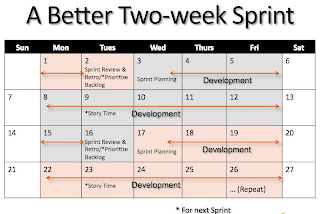
Fortunately, there is an extremely simple method of fixing these (and many other) common problems resulting from Monday-Friday Sprint boundaries: start and finish in the middle of the week. I personally like starting fresh with Sprint Planning on Wednesday mornings and wrapping up with the Sprint Review and Retrospective on Tuesday afternoons. Using this Sprint boundary template immediately remedies the Monday-holiday disruption. Finishing the Sprint on Tuesday afternoon -- with the Retrospective as the last thing the team does, always, without fail -- very neatly eliminates "we're done, but we'll finish over the weekend" syndrome as well. This one element, finishing work, is worthy of another blog post all to itself.
Another benefit of the Wednesday-Tuesday Sprint cycle is that it supports adherence to an oft-violated Agile principle: sustainable pace. As a coach, I am not about to encourage or even allow teams to get into the habit of working weekends between Sprints. The most effective way I have discovered to deal with this problem is simply to make it impossible: there is no weekend or other exploitable time between Sprints.
Closing out each Sprint on Tuesday with the Retrospective provides the team with the full experience of accomplishment and closure, of finishing the work of one Sprint before moving on to the next. Indeed, I invariably find that teams are anxious to get started on the next Sprint and welcome the opportunity to start fresh the very next morning. An added benefit is that holding Sprint celebrations on Tuesdays often results in a smaller tab at the team's favorite restaurant or bar, which often offer discounts to encourage mid-week trade.
Think about it and let me know about your experience with Sprint boundaries.
All for now....
...-.-
In any case, the questions that form the title of this post are among the most frequently asked when I am both training and coaching. The context is Sprint begin-end boundaries and the answers I give are consistent. I encourage organizations and teams to follow the Lean principle of building-in quality, that is, make everything as unlikely to break as possible. When it comes to Sprint boundaries, regardless of the length of the Sprints, the least likely candidates are starting on Mondays and ending on Fridays.
There are several reasons why Monday-Friday Sprint boundaries are suboptimal. In the USA at least, most holidays fall on Mondays, almost certainly assuring disruption of Sprint planning at least a few times every year. And while ending Sprints on Fridays might seem to offer the prospect of a nice break in between Sprints, the all-too-common refrain from the team at the Sprint Review is: "Oh yeah, we're done with everything, but we just have a little testing/coding/cleanup, etc., to finish over the weekend." Uh-oh.

Fortunately, there is an extremely simple method of fixing these (and many other) common problems resulting from Monday-Friday Sprint boundaries: start and finish in the middle of the week. I personally like starting fresh with Sprint Planning on Wednesday mornings and wrapping up with the Sprint Review and Retrospective on Tuesday afternoons. Using this Sprint boundary template immediately remedies the Monday-holiday disruption. Finishing the Sprint on Tuesday afternoon -- with the Retrospective as the last thing the team does, always, without fail -- very neatly eliminates "we're done, but we'll finish over the weekend" syndrome as well. This one element, finishing work, is worthy of another blog post all to itself.
Another benefit of the Wednesday-Tuesday Sprint cycle is that it supports adherence to an oft-violated Agile principle: sustainable pace. As a coach, I am not about to encourage or even allow teams to get into the habit of working weekends between Sprints. The most effective way I have discovered to deal with this problem is simply to make it impossible: there is no weekend or other exploitable time between Sprints.
Closing out each Sprint on Tuesday with the Retrospective provides the team with the full experience of accomplishment and closure, of finishing the work of one Sprint before moving on to the next. Indeed, I invariably find that teams are anxious to get started on the next Sprint and welcome the opportunity to start fresh the very next morning. An added benefit is that holding Sprint celebrations on Tuesdays often results in a smaller tab at the team's favorite restaurant or bar, which often offer discounts to encourage mid-week trade.
Think about it and let me know about your experience with Sprint boundaries.
All for now....
...-.-
Subscribe to:
Posts (Atom)